
Start here: Choose one prompt, write a few sentences, and finish with one small action or a decision to leave something for later. You can use paper, a notebook or a private note on your device. You do not need a special journal.
This guide offers seven everyday reflection prompts, a five-minute format and a completed example. Use whichever part fits your day; there is no score and no need to finish every question.
How to start a five-minute journaling session
- First minute: choose one situation. Name something specific, such as a crowded to-do list or an unfinished conversation. Keep the focus small.
- Next three minutes: answer one prompt. Write in plain language. Bullet points count. If you get stuck, begin with “Right now, I notice…”
- Last minute: close the page. Underline one thing you can do, ask or postpone. You can also write “Nothing more to decide today.”
Five minutes is a convenient limit for this exercise, not a scientifically established dose or a promise of a particular result. Shorten it or stop whenever you want.
Seven prompts to choose from
1. What is taking up the most space in my thoughts today?
Name one topic instead of listing every problem at once. For example, “I have three tasks due tomorrow” is a more specific starting point than “Everything is too much.” Then write what you know about that situation.
2. What do I know, and what am I guessing?
Make two short lists: facts you can check and interpretations you are making. “I have not received a reply” is an observation. “They are upset with me” is a possible interpretation. You do not have to replace it with a positive story; simply label what is uncertain.
3. Which part can I act on today?
Choose an action that is yours to take: send a question, gather a document or put one appointment in your calendar. Separate it from outcomes that depend on other people. Keep the action small enough to describe in one sentence.
4. What can wait until a specific time?
If something needs attention later, write when you will return to it. “Review my list tomorrow after breakfast” is clearer than “Deal with everything soon.” This is a planning choice, not a requirement to ignore something urgent.
5. What would make the next task easier to begin?
Think about practical preparation: open the right file, clear a small workspace or ask what the first step is. Write the setup action rather than another large goal.
6. What went reasonably well, even if the day was difficult?
Choose a concrete detail: you ate lunch, answered a message or finished part of a task. You can acknowledge difficulty alongside that detail. There is no need to force gratitude or describe a hard day as a good one.
7. What do I want to remember when I close this page?
Finish with a reminder you can actually use: “I only need to draft the first paragraph” or “I can ask for clarification.” Avoid promises you cannot control, such as “Tomorrow will be perfect.”
A completed journal entry
The following is a fictional example showing the format, not a customer testimonial.
Situation: I have three tasks on tomorrow’s list and keep switching between them.
Prompt: Which part can I act on today?
Entry: I cannot finish all three tonight. I can check which deadline comes first and gather what I need for that task. I am assuming they are all equally urgent, but I have not checked.
Closing step: Look at the deadlines, put the first task at the top of the list, then stop planning for tonight.
Make a reusable page in any notebook
Copy these four lines. Leave as much space as you prefer between them.
- Today’s situation: __________
- The prompt I chose: __________
- My response: __________
- One next step, or what can wait: __________
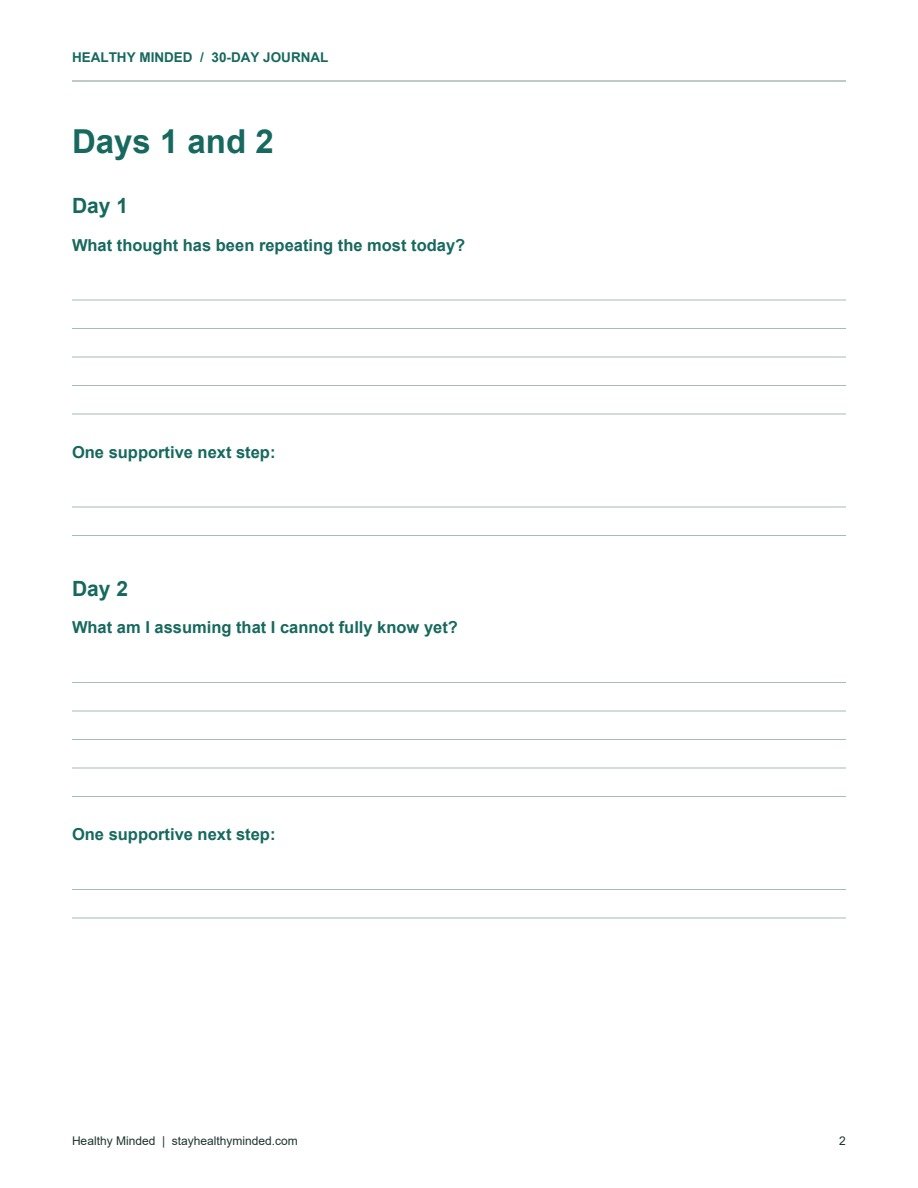
For a look at a formatted printable, view an actual sample page from our 30-day journal. The sample belongs to our paid bundle; the prompts and notebook format on this page are free to use personally.
Common questions
Do I need to answer all seven prompts?
No. Choose one that matches the situation you want to write about. Repeating a useful prompt is fine.
Should I journal in the morning or evening?
Choose a time that fits your routine. A morning entry can focus on one priority; an evening entry can focus on what to leave for tomorrow. You can pair this format with our morning routine guide.
What if I miss a day?
Start a new entry when you want to return. You do not need to catch up or maintain a streak.
What if writing makes me feel worse?
You do not need to continue. Stop the exercise and choose another activity or seek support. These are general reflection prompts, not treatment or a substitute for professional care.
Want a ready-to-print journal?
Healthy Minded publishes the Calm Reset System printable journaling bundle: seven PDFs, including a 30-day journal and seven-day routine, plus two optional MP3 tracks. It is a $37 one-time digital purchase. Review the sample pages and full contents before deciding whether you need it; a notebook is enough to use this free guide.
Published by Healthy Minded, the creator of the Calm Reset System. This guide was prepared with AI writing assistance and uses original instructional examples. It does not describe clinical research or a tested treatment protocol.